When dealing with a real estate broker in the Philippines, you may come across the terms “PRC and DHSUD license.” While commonly used together, a PRC license and DHSUD registration are separate credentials that serve different purposes.
Although they are related, they are not the same thing. They serve different purposes and are issued by different government agencies.
Understanding the difference can help property buyers and sellers know what to look for, particularly when dealing with subdivision and condominium projects.
What is a PRC License?
The Professional Regulation Commission (PRC) regulates and licenses professionals in the Philippines, including real estate brokers and other real estate service practitioners.
A PRC-licensed Real Estate Broker is a professional who has met the applicable requirements for registration and licensure to practice real estate brokerage. PRC issues the broker’s Certificate of Registration and Professional Identification Card (PIC), subject to the applicable rules and renewal requirements.
In simple terms: PRC license = professional license to practice as a Real Estate Broker.
This is why checking a broker’s PRC credentials is an important first step when choosing someone to assist with a real estate transaction.
What is DHSUD Registration?
The Department of Human Settlements and Urban Development (DHSUD) has regulatory responsibilities relating to housing and real estate development, including the registration of real estate brokers and salespersons engaged in the selling of subdivision lots and condominium units.
DHSUD’s current Citizen’s Charter describes the registration of real estate brokers, salespersons, dealers, and business firms as the granting of authority to engage in the business of selling subdivision lots or condominium units.
In simple terms: DHSUD registration = registration connected to authority to engage in project selling, particularly subdivision and condominium projects.
This is why DHSUD registration becomes especially relevant when a broker or salesperson is marketing a developer’s project.
PRC and DHSUD Serve Different Purposes
The easiest way to understand the distinction is to look at what each credential establishes.
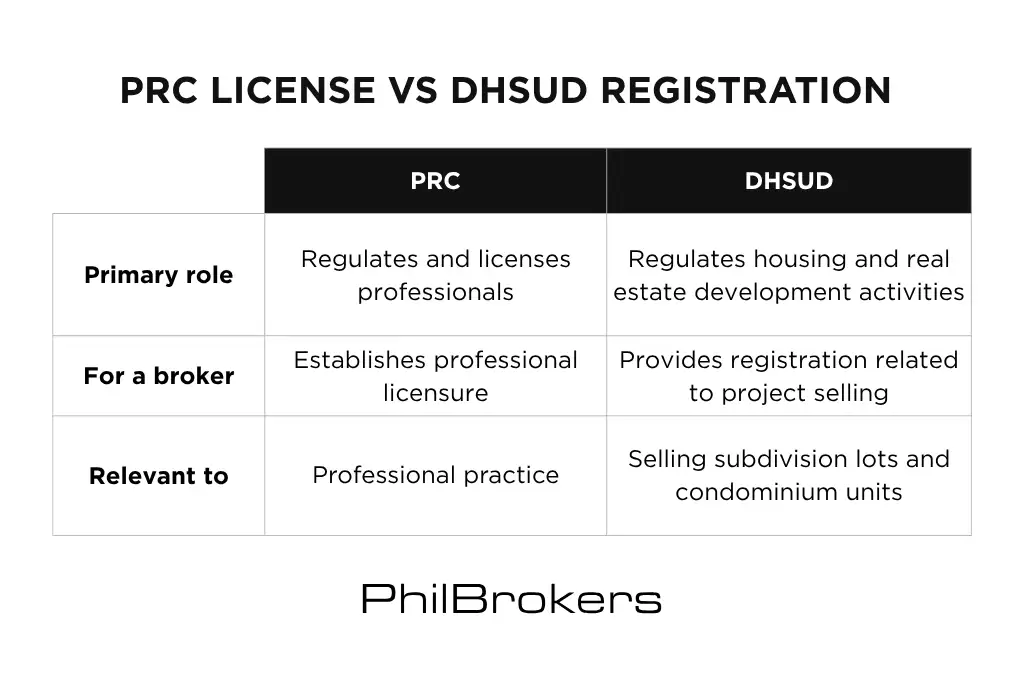
The two are therefore complementary rather than interchangeable.
In fact, DHSUD’s registration requirements for brokers include a valid PRC Certificate of Registration and Professional Identification Card.
That means a DHSUD registration does not replace the need for the broker’s PRC credentials.
When Should You Check DHSUD Registration?
DHSUD registration becomes particularly relevant when you are dealing with project selling.
For example, if a broker or salesperson is marketing:
- a condominium development;
- a subdivision;
- a house-and-lot project; or
- subdivision lots within a development,
you may want to ask whether the person is properly registered with DHSUD for the applicable project-selling activity.
DHSUD’s registration requirements distinguish between brokers and salespersons. For salespersons, the requirements include a letter of engagement or employment from a DHSUD-registered dealer or broker and proof of the broker’s updated DHSUD registration.
This is another reason why knowing whether you are dealing with a broker or salesperson matters.
PRC License Does Not Automatically Mean Authorization to Market Every Property
This is an important point for property seekers.
A person may have a valid PRC license, but that does not automatically establish that they are authorized to market every property or project they advertise.
For project selling, ask whether the broker or salesperson is accredited or authorized by the developer or authorized dealer to market the specific project.
For resale or general brokerage, ask how the property owner has authorized the broker to market the property.
This is why professional verification should be followed by property-specific due diligence
Why the Distinction Matters
The terms PRC-licensed and DHSUD-registered can sometimes appear together in property marketing, but they should not be treated as interchangeable credentials.
A PRC license tells you about the professional’s license to practice. DHSUD registration can establish the professional’s registration related to project selling, while a DHSUD License to Sell relates to the project and the developer’s authority to sell it.
Understanding these distinctions gives property seekers a better starting point for evaluating the professionals, projects, and properties they encounter.